Second Quarter 2025 Quarterly Market Recap

July 2, 2025
Get Comfortable Being Uncomfortable

The second quarter of 2025 was a volatile period for global equity markets, reflecting significant uncertainty driven by the implementation of “Liberation Day” tariffs, mixed economic data, and weakening consumer sentiment. The S&P 500 ended the quarter with a modest positive YTD gain, recovering from the -18.9% decline from its February peak, triggered by the introduction of tariffs in April. Despite the market recovering from steep sell-offs, key economic data the Federal Reserve tracks have started to slow. 

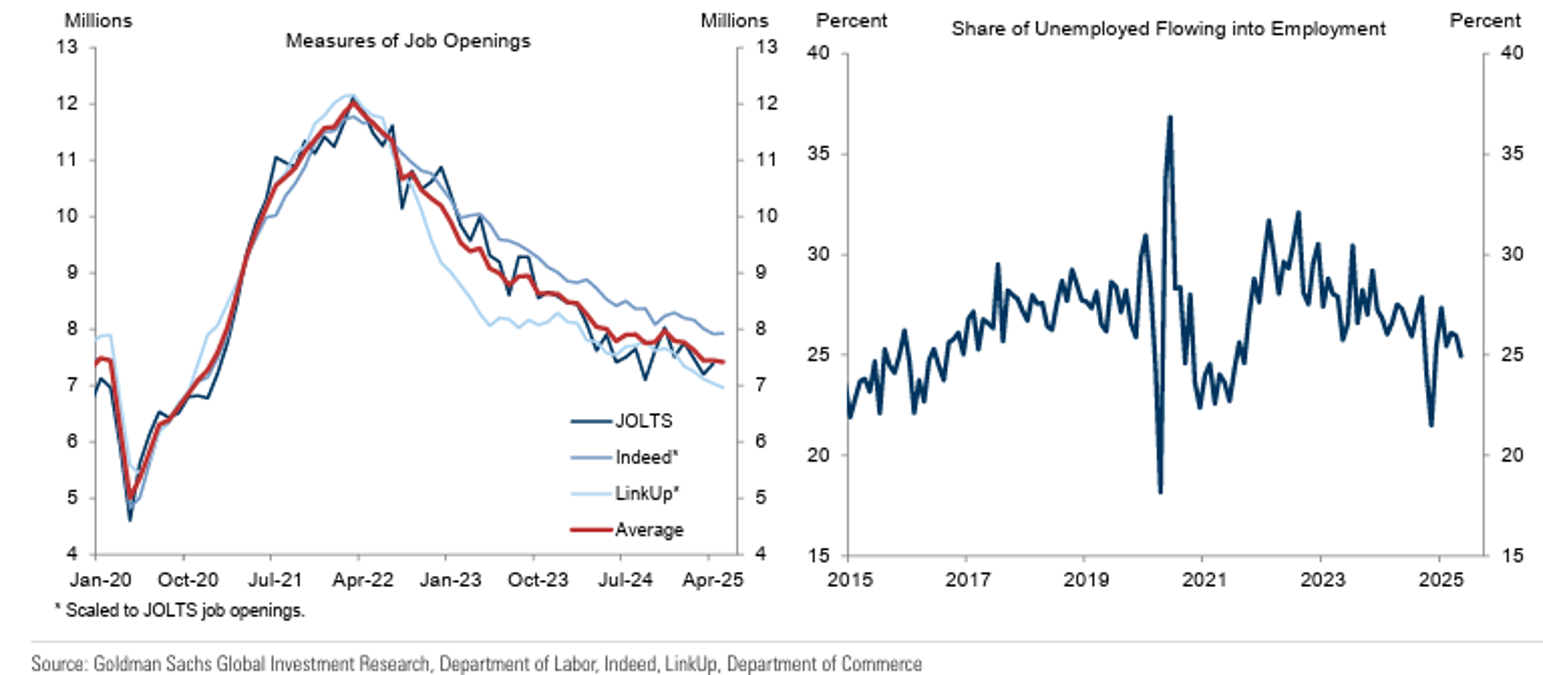
The US labor market has remained resilient, as April’s jobs report added 177,000 nonfarm payrolls, surpassing estimates of 150,000. The unemployment rate moved up to 4.2% from 4.1% in March and wage growth moderated to +3.8% Y/Y growth, aligning with the Federal Reserve’s target of stable inflation. The labor market data has shown that companies have cut back on hiring but are not laying off workers at a material rate. As illustrated below, the monthly Job Openings and Labor Turnover Survey (JOLTS) has shown openings slowing and it has become harder for unemployed workers to find a new job.


The US housing market exhibited signs of stabilization amid affordability challenges, with increased new and used home inventory levels. Median home prices have risen for 20 consecutive months, though the pace of growth has slowed compared to prior quarters. Mortgage rates remained elevated, which has also tempered consumer demand. Housing inventory has improved to a 4.4 month supply, the highest since the pandemic, providing buyers with more options. Affordability concerns and economic uncertainty for the second half of 2025 continue to drive a cautious housing market outlook. 


Outlook:


Our recent 1Q 2025 Market Outlook was titled: Looking for Mispriced Opportunities in a Chaotic Market. Behavioral science reminds us that investors tend to be swayed by their short-term emotions during times of uncertainty, instead of relying on longer-term fundamental business and financial analysis. During periods of investor angst and worry, history has shown that attractive investment opportunities are often created due to valuation dislocations and market misperception. We were able to identify attractive opportunities across a variety of sectors and industries during the recent market turmoil that should add value to our clients’ portfolios in future periods. Importantly, we continue to see more attractive investment opportunities at present than earlier in the year, leading us to expand our watch list for potential equity strategy additions. At Oliver Luxxe, we remain focused on valuation and strong business models, with a long-term view that owning quality businesses with attractive reinvestment opportunities tend to create shareholder value.


As always please reach out with any questions or concerns.


Thank you,

​Joseph Sharma, CFA 

Chief Investment Officer 

Direct: (908) 741-8340 
joe.s@oliverluxxe.com


Disclaimer:

Investments in securities entail risk and are not suitable for all investors. This is not a recommendation nor an offer to sell (or solicitation of an offer to buy) securities in the United States or in any other jurisdiction. All investment strategies have the potential for profit or loss; changes in investment strategies may materially alter the performance and results of a portfolio. Different types of investments involve varying degrees of risk, and there can be no assurance that any specific investment will be suitable or profitable for a client’s investment portfolio.

This document may contain forward-looking statements relating to the objectives, opportunities, and the future performance of the US market generally. Forward-looking statements may be identified by the use of such words as; “believe,” “expect,” and other similar terms. Examples of forward-looking statements include, but are not limited to, estimates with respect to the success or lack of success of any particular investment strategy. All are subject to various factors, including, to general and local economic conditions, changes in interest rates, changes in legislation or regulation, and other economic, competitive, governmental, and technological factors affecting a portfolio’s operations that could cause actual results to differ materially from projected results. Such statements are forward-looking in nature and involve a number of known and unknown risks, uncertainties and other factors, and accordingly, actual results may differ materially from those reflected or contemplated in such forward-looking statements. Prospective investors are cautioned not to place undue reliance on any forward-looking statements or examples. None of Oliver Luxxe or any of its affiliates or principals nor any other individual or entity assumes any obligation to update any forward-looking statements as a result of new information, subsequent events or any other circumstances. All statements made herein speak only as of the date that they were made.


January 8, 2026
The fourth quarter of 2025 capped off a resilient year for U.S. equities, with major indices posting positive returns amid moderating economic growth, persistent inflation pressures, and a cautious Federal Reserve. The S&P 500 advanced approximately 2.7% in Q4, contributing to a full-year gain of around 18%, driven largely by technology, AI, and communication services sectors. This represents the third consecutive year of double-digit gains. Despite headwinds from policy uncertainty and a projected economic slowdown, markets climbed a "wall of worry," with investors rebalancing portfolios and corporate optimism supporting rallies. Key risks heading into 2026 include potential policy shifts, below-trend GDP growth, and inflation drifting above the Fed's target. As we enter 2026, we believe the global economy should transition to a period of improved economic stability as the path of global trade become clearer. We believe the US equity market should experience measured progress amid a resilient yet evolving economic landscape. In 2026, US equity returns should be driven by fundamentals, particularly earnings growth, rather than further valuation multiple expansion, as current multiples are already above long-term averages. Importantly, corporate profit margins are set to improve in 2026, as companies benefit from operational efficiencies, AI productivity gains (albeit on low adoption rates), and moderating input costs. Additionally, financial conditions are expected to become easier than in early 2025 (see charts below).
October 14, 2025
Discover how the 80/20 Business System helps companies boost efficiency, profitability, and ROIC through strategic resource optimization.
April 22, 2025
Looking for Mispriced Opportunities in a Chaotic Market The global equity markets have recently experienced a significant period of volatility, shaped by a mix of macroeconomic developments and policy shifts. The sell-off in the S&P 500 was driven mostly by tariff-related concerns, though it managed a partial recovery toward the end of the quarter. Concerns around economic growth intensified, fueled by softer economic data and uncertainty surrounding the broader “Trump 2.0” policy framework. Survey data reflected this caution, as the March Michigan Consumer Sentiment Index fell to its lowest since November 2022, with one-year inflation expectations rising to 5% and five-year expectations hitting a 32-year high of 4.1%. The March Consumer Confidence Index also dropped to its lowest since January 2021, with the expectation component reaching a 12-year low. Manufacturing PMI swung back into contraction, with cost pressure rising at the sharpest pace in 23 months. All in, the S&P 500 declined -4.59% in 1Q25, which marked its weakest performance since 3Q22. The best-performing sectors were Energy (+9.30%), Healthcare (+6.08%) and Consumer Staples. Conversely, sectors that underperformed were Industrials (0.53%), Communication Services (-6.41%), and Technology (-12.79%). High single-stock concentration levels in the S&P 500 Index, Deep Seek Artificial Intelligence developments, and elevated valuation multiples resulted in the Magnificent Seven stocks underperforming the broader market. In fact, the Magnificent Seven collectively fell into bear market territory, as the group declined -15% during 1Q25 and is now down -20% since the peak in December 2024.
March 3, 2025
White Paper: The Importance of Reinvestment Opportunities in Driving Intrinsic Value Executive Summary At Oliver Luxxe, we believe that the intrinsic value of an asset stems from its ability to generate sustainable cash flows over time, discounted at an appropriate required rate of return. Central to this valuation framework are three key drivers: return on invested capital (ROIC) , reinvestment opportunities , and the quality and sustainability of earnings . Through our proprietary quantitative screening process and rigorous fundamental analysis, we seek to identify companies with these characteristics. Our "Private Equity in the Public Marketplace" approach integrates detailed financial modeling and competitive positioning analysis to uncover businesses with compelling reinvestment opportunities. This white paper explores the critical role of reinvestment opportunities in value creation, the metrics that illuminate a firm’s capacity to reinvest effectively, and how sustainable free cash flow acts as a catalyst for long-term growth. The Foundations of Intrinsic Value We believe the value of any asset is fundamentally tied to the present value of its future cash flow, discounted by a rate that reflects the risk and opportunity cost of capital. For equity investors, this translates into a focus on three interconnected pillars: Return on Invested Capital (ROIC): A measure of how efficiently a company allocates its capital to generate profits. Reinvestment Opportunities: The ability of a firm to deploy excess cash into high-return projects, whether through organic growth or inorganic strategies like mergers and acquisitions (M&A). Quality and Sustainability of Earnings: The reliability and resilience of a company’s earnings across economic cycles, providing the fuel for reinvestment. While our proprietary quantitative analysis helps us to systematically identify companies exhibiting these traits, the cornerstone of our process at Oliver Luxxe is detailed fundamental due diligence. This includes constructing discounted cash flow (DCF) models, performing comparable company analyses, and evaluating a firm’s competitive moat. By adopting a “private equity” mindset within the public markets, we aim to uncover businesses that not only generate strong returns but also possess the capacity to reinvest those returns at above-market rates. Reinvestment Opportunities: Organic and Inorganic Growth Reinvestment opportunities define a company’s ability to compound value over time. These opportunities fall into two categories: Organic Spending: Investments in existing operations, such as expanding production capacity, increasing R&D investments, enhancing product lines, or improving efficiency. Inorganic Spending: Accretive M&A that strengthens market position, diversifies revenue streams, or unlocks synergies. The success of reinvestment hinges on the availability of excess cash and management’s ability to deploy it at attractive rates of return. Consider a hypothetical example: A company generates $10.00 in revenue and $5.00 in net income (a 50% net margin). It converts 100% of its net income into free cash flow (FCF), yielding $5.00. Management reinvests $2.50 (a 50% reinvestment rate) at a ROIC of 30%, well above its WACC of 10%. This $2.50 grows to $3.00 in value, while the remaining $2.50 of FCF remains available for other uses, such as dividends, debt reduction, or further reinvestment. This "flywheel" effect, where high ROIC compounds through disciplined reinvestment, distinguishes exceptional businesses from average ones. However, the flywheel only spins if earnings are both high-quality and sustainable. The Oliver Luxxe Principles Our "Private Equity in the Public Marketplace" philosophy sets us apart by blending the rigor of private equity analysis with the liquidity and diversity of public markets. We prioritize companies with: High and sustainable ROIC relative to WACC. Robust reinvestment opportunities that may signal above-market returns. Durable earnings and free cash flow to fund those opportunities. By combining quantitative analysis with deep fundamental research, we seek to uncover undervalued businesses poised for long-term value creation. Our financial models project cash flows over multi-year horizons, while our competitive analysis seeks to ensure that reinvestment opportunities are defensible against industry rivals. Conclusion We believe reinvestment opportunities are a critical yet often overlooked driver of intrinsic value. Companies that can generate high returns on invested capital and are able to reinvest those returns at attractive rates can compound wealth beyond their peers. At Oliver Luxxe, our disciplined process seeks to identify these opportunities, leveraging both data-driven insights and hands-on analysis. In a market where short-term noise often overshadows long-term fundamentals, our focus on sustainable cash flows and reinvestment potential positions us—and our investors—for long-term success. Disclosures: All investment strategies have the potential for profit or loss. Different types of investments involve varying degrees of risk, and there can be no assurance that any specific investment will be suitable or profitable for a client's investment portfolio. This is not a recommendation nor an offer to sell (or solicitation of an offer to buy) securities in the United States or in any other jurisdiction.
January 30, 2025
Is the Glass Still Half Full? The S&P 500 rose 23% in 2024, following a 24% gain in 2023. As we enter 2025, we continue to expect solid economic growth, stronger US productivity, and favorable interest rate policies by global central banks. The US is expected to remain the global economic growth driver with expansion of the current business cycle, increased AI-related capital spending, solid employment growth, and prospects for increasing capital markets activities. Despite this favorable backdrop, there are a variety of factors that may affect US equity performance in 2025. First, we believe much of the robust earnings growth in 2023 and 2024 has been reflected in equity valuations, especially in the fastest-growing AI-related stocks (see below). Over the last two years, higher interest rates combined with the AI capex boom were a key driver of outsized performance by a narrow group of stocks. However, we think these elevated valuation levels leave little margin for error. We think it also places a constraint on the upside for outsized equity gains in 2025.